
 Emily Carter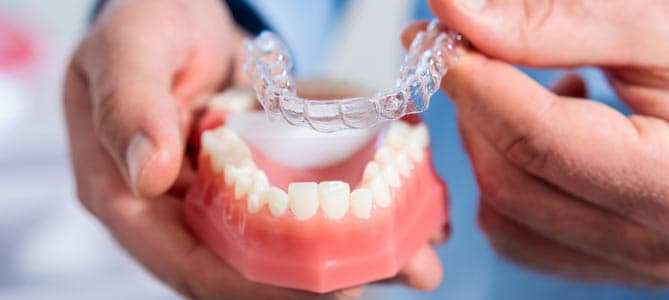
At a Glance
- The five main types of braces are traditional metal, ceramic, lingual, self-ligating, and clear aligners like Invisalign.
- Metal braces remain the most versatile and affordable option for complex orthodontic cases, costing $3,000 to $7,000.
- Clear aligners work best for mild to moderate crowding and spacing, with the advantage of being removable and nearly invisible.
- Treatment time ranges from 6 months for simple cases to 36 months for severe misalignment, regardless of brace type.
- Your orthodontist will recommend the best option based on your specific diagnosis, budget, and lifestyle preferences.
Choosing the right type of braces is one of the biggest decisions in your orthodontic journey. With more options available today than ever before, the choice is no longer just between metal brackets and rubber bands. Each type of braces has distinct advantages depending on your case complexity, budget, lifestyle, and how visible you want the treatment to be.
This guide breaks down all five major types of braces, what each one does best, what it costs, and who it is right for, so you can have an informed conversation with your orthodontist.
1. Traditional Metal Braces
Metal braces are the most recognizable orthodontic appliance and have been used for decades. They consist of stainless steel brackets bonded to the front of each tooth, connected by a metal archwire. Small elastic bands (ligatures) hold the wire in place, and your orthodontist tightens or adjusts the wire at regular appointments to gradually shift your teeth.
Pros
- Most versatile. Metal braces can correct virtually any orthodontic issue, from mild crowding to severe bite problems (overbite, underbite, crossbite, open bite).
- Most affordable. Typically the least expensive option at $3,000 to $7,000, making them accessible for more patients.
- Reliable and time-tested. Decades of clinical evidence support their effectiveness for complex cases.
- No compliance required. Since they are fixed to your teeth, you cannot forget to wear them or lose them.
Cons
- Highly visible. The metallic appearance is the most noticeable of all brace types.
- Dietary restrictions. You need to avoid hard, sticky, and chewy foods that can damage brackets or wires.
- Harder to clean. Brushing and flossing around brackets takes extra time and technique.
- Discomfort after adjustments. Soreness for a few days after each tightening appointment is common.
Best For
Complex orthodontic cases, severe misalignment, significant bite corrections, children and teens who may not reliably wear removable appliances, and patients looking for the most cost-effective option.
2. Ceramic Braces (Clear Braces)
Ceramic braces work exactly like metal braces but use tooth-colored or clear brackets instead of stainless steel. The archwire can also be tooth-colored, making the entire system much less noticeable. They have the same mechanical capability as metal braces while offering a more discreet appearance.
Pros
- Less visible than metal. Tooth-colored brackets blend with your teeth, making them a popular choice for adults and image-conscious teens.
- Same effectiveness as metal braces. Ceramic braces can treat the same range of orthodontic issues as traditional metal braces.
- Fixed appliance. No compliance concerns since the brackets stay on your teeth throughout treatment.
Cons
- More expensive than metal. Ceramic braces typically cost $4,000 to $8,000 due to the higher cost of materials.
- Brackets can stain. The clear or tooth-colored brackets may discolor over time if you drink a lot of coffee, tea, or red wine, or if you smoke.
- Slightly more fragile. Ceramic brackets are more prone to chipping or breaking than metal ones, so you still need to be careful with hard foods.
- Same dietary restrictions as metal braces. All the same food rules apply.
Best For
Adults and teens who need the full correction power of traditional braces but want a less visible option. A good middle ground between effectiveness and aesthetics.
3. Lingual Braces
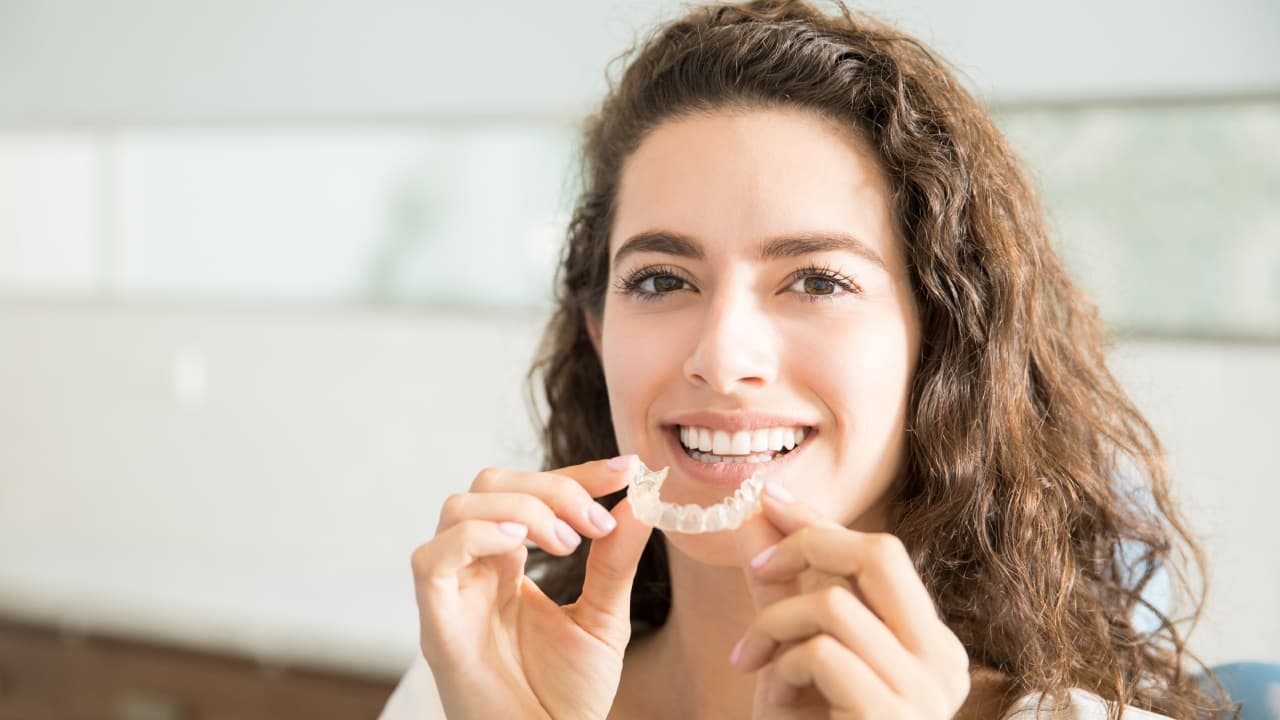
Lingual braces are placed on the back (tongue side) of your teeth instead of the front. They use custom-made brackets that conform to the inner surface of each tooth. Because they sit behind your teeth, they are completely invisible when you smile.
Pros
- Completely invisible. No one can see lingual braces unless they look inside your mouth. This makes them the most discreet fixed-bracket option.
- Effective for complex cases. Lingual braces can treat many of the same issues as traditional braces, including bite corrections.
- Custom fit. Each bracket is individually manufactured to match the unique contours of your teeth.
Cons
- Most expensive option. Custom fabrication makes lingual braces the priciest choice at $8,000 to $13,000.
- Longer adjustment period. Having brackets on the tongue side can affect your speech initially and cause tongue irritation for the first few weeks.
- Harder to clean. The brackets are in a hard-to-reach location, making oral hygiene more challenging.
- Not widely available. Fewer orthodontists offer lingual braces because they require specialized training and additional lab time for custom brackets.
- Longer appointments. Adjustments take more time because the brackets are harder for the orthodontist to access.
Best For
Adults in professional or public-facing roles who need fixed braces but want zero visibility. Budget is less of a concern, and the case requires more correction than clear aligners can provide.
4. Self-Ligating Braces
Self-ligating braces look similar to traditional braces but use a built-in clip mechanism on the bracket to hold the archwire instead of elastic ligatures. This means fewer moving parts and potentially less friction on the wire as your teeth move. They come in both metal and ceramic (clear) versions.
Pros
- Fewer and shorter appointments. Without elastic ligatures to replace, adjustment visits can be faster and may be needed less frequently.
- Less friction. The clip mechanism allows the wire to slide more freely, which some studies suggest may reduce treatment time for certain cases.
- Easier to keep clean. Without elastic bands trapping food and plaque, brushing around the brackets is somewhat simpler.
- Available in clear versions. Ceramic self-ligating brackets offer a more discreet option similar to ceramic braces.
Cons
- Slightly more expensive than metal braces. Self-ligating systems typically cost $4,000 to $8,000 due to the specialized bracket design.
- Still visible. Even the clear versions are attached to the front of your teeth, so they are more noticeable than lingual braces or clear aligners.
- Same dietary restrictions. Hard and sticky foods can still damage the brackets and wires.
Best For
Patients who want the reliability of fixed braces with fewer office visits. A good option for busy adults and teens, especially if you choose the ceramic version for a more subtle appearance.
5. Clear Aligners (Invisalign)
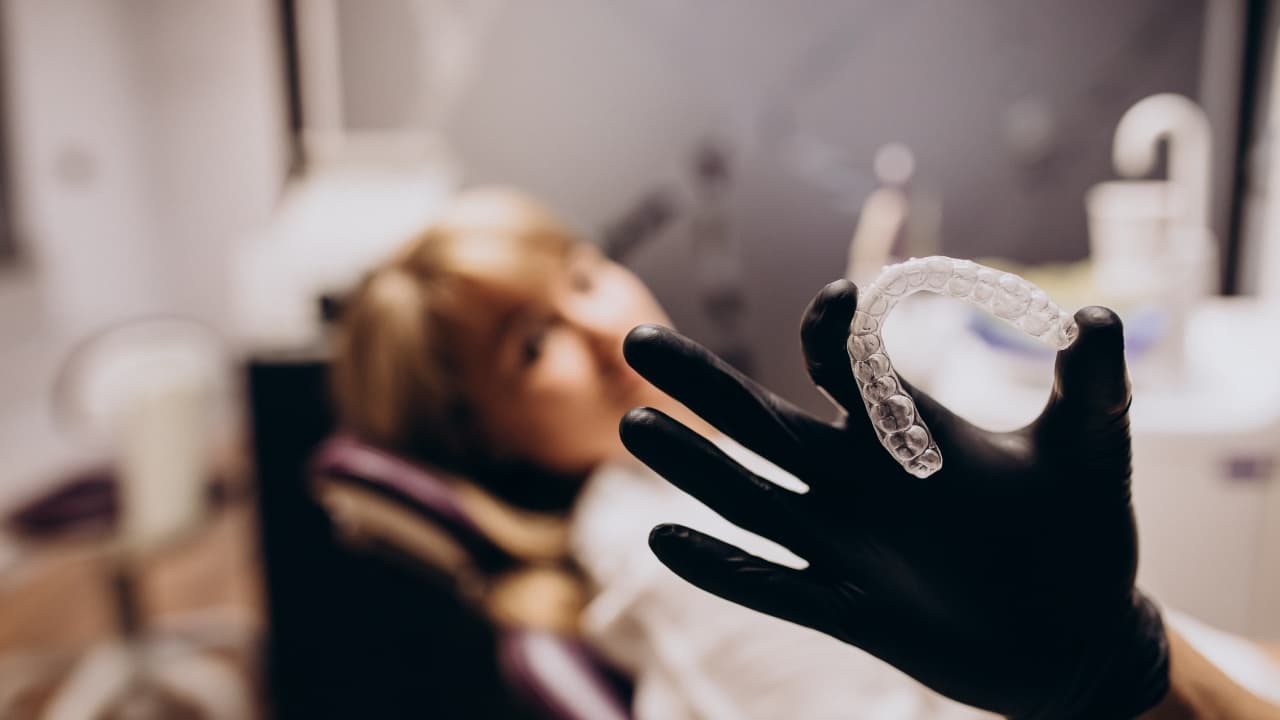
Clear aligners are a fundamentally different approach to orthodontics. Instead of brackets and wires, you wear a series of custom-made, removable plastic trays that gradually shift your teeth. Each set of trays is worn for about one to two weeks before moving to the next set in the series. Invisalign is the most well-known brand, but several other clear aligner systems exist.
Pros
- Nearly invisible. The clear plastic trays are extremely difficult to notice, making them the top choice for adults who want discreet treatment.
- Removable. You take them out to eat, drink, brush, and floss. This means no dietary restrictions and easier oral hygiene.
- More comfortable. Smooth plastic trays cause less irritation to your cheeks and gums than metal brackets and wires.
- Fewer office visits. Check-in appointments are typically every 6 to 8 weeks instead of every 4 weeks with braces.
- Predictable results. Digital treatment planning shows you a 3D preview of your expected outcome before you start.
Cons
- Requires discipline. You must wear the aligners 20 to 22 hours per day for them to work. Taking them out too often will delay or compromise your results.
- Not ideal for severe cases. Complex bite corrections, significant tooth rotations, and vertical movements are still better handled by traditional braces. However, the technology continues to improve each year.
- Can be lost or damaged. Because they are removable, aligners can be misplaced. Replacement trays add cost and can delay treatment.
- Cost is comparable to or higher than metal braces. Invisalign costs typically range from $3,000 to $8,000 depending on case complexity.
Best For
Adults and responsible teens with mild to moderate crowding, spacing, or bite issues who want a discreet, comfortable, and flexible treatment experience. Invisalign is highly effective for the right candidates, with a 96% patient satisfaction rate.
Side-by-Side Comparison
| Feature | Metal | Ceramic | Lingual | Self-Ligating | Clear Aligners |
|---|---|---|---|---|---|
| Visibility | High | Low | None | Medium | Very low |
| Cost Range | $3K–$7K | $4K–$8K | $8K–$13K | $4K–$8K | $3K–$8K |
| Treatment Time | 18–24 mo | 18–24 mo | 18–36 mo | 18–24 mo | 6–18 mo |
| Case Complexity | All | All | Most | All | Mild–Moderate |
| Removable | No | No | No | No | Yes |
| Diet Restrictions | Yes | Yes | Yes | Yes | No |
| Office Visits | Every 4 wk | Every 4 wk | Every 4–6 wk | Every 6–8 wk | Every 6–8 wk |
Choosing Braces by Age
Children (Ages 7 to 12)
The American Association of Orthodontists recommends a first orthodontic evaluation by age 7. At this stage, the jaw is still growing, which gives the orthodontist an opportunity to guide development and address problems early. Phase 1 (early) treatment may involve partial braces, expanders, or space maintainers. Not every child needs early treatment, but catching certain issues early can simplify later treatment significantly.
Teens (Ages 12 to 18)
This is the most common age for comprehensive orthodontic treatment. Most permanent teeth have erupted, and the jaw is still growing, which helps teeth move more efficiently. Traditional metal braces are the most popular choice for teens, though ceramic braces and Invisalign Teen are increasingly common. For teens who may struggle with compliance, fixed braces are often a more reliable option than removable aligners.
Adults
About 25% of orthodontic patients today are adults. Treatment works at any age, though it may take slightly longer since adult bone is denser and no longer actively growing. Adults tend to favor clear aligners and ceramic braces for aesthetic reasons. If you are considering orthodontic treatment as an adult, cosmetic dentistry options like dental bonding or veneers can complement your results after treatment is complete.

Cost and Insurance Coverage
Orthodontic treatment is a significant investment. Here is what you can generally expect:
- Metal braces: $3,000 to $7,000
- Ceramic braces: $4,000 to $8,000
- Lingual braces: $8,000 to $13,000
- Self-ligating braces: $4,000 to $8,000
- Clear aligners (Invisalign): $3,000 to $8,000
Many dental insurance plans include orthodontic benefits, typically covering $1,000 to $3,000 of the total cost. Coverage often applies equally to all types of braces, though some plans limit coverage for cosmetic options like lingual braces. Check with your insurance provider to understand your specific benefits.
If cost is a concern, most orthodontic offices offer payment plans. You may also be able to use financing options like CareCredit, Cherry, or Sunbit to spread the cost over time with low or no interest.
What to Expect During Treatment
Regardless of which type of braces you choose, the general process follows a similar path:
- Initial consultation. Your orthodontist examines your teeth, takes X-rays and impressions (or digital scans), and discusses treatment options and costs.
- Placement day. For fixed braces, brackets are bonded to your teeth and the archwire is threaded through. For clear aligners, you receive your first sets of trays along with instructions on wear time and tray changes.
- Regular adjustments. You visit the office every 4 to 8 weeks (depending on the type) for adjustments, progress checks, and new aligner trays if applicable.
- Removal and retention. Once your teeth have reached their final positions, braces are removed and you receive a retainer. Most patients need to wear a retainer at night indefinitely to prevent teeth from shifting back.
Retainers After Braces
No matter which type of braces you choose, retainers are a non-negotiable part of the process. Teeth have a natural tendency to shift back toward their original positions, especially in the first year after treatment. Your orthodontist will recommend either a removable retainer (worn at night) or a permanent bonded retainer (a thin wire fixed behind your front teeth). Many patients use a combination of both.
Skipping retainer wear is the most common reason people lose their orthodontic results. Treat your retainer as a lifetime commitment, not just a post-treatment phase.
How to Choose the Right Type of Braces
Choosing the best braces comes down to balancing four factors:
- Case complexity. Severe bite problems, large gaps, or significant rotations often require traditional or self-ligating braces. Mild crowding or spacing can usually be treated with clear aligners.
- Aesthetics. If visibility is your top concern, clear aligners and lingual braces offer the most discreet options. Ceramic braces are a solid middle ground.
- Budget. Metal braces are the most affordable. Clear aligners and ceramic braces fall in the middle. Lingual braces are the most expensive.
- Lifestyle. If you play contact sports, a removable option like clear aligners may be more convenient (and you can wear a sports mouthguard without interference). If you do not trust yourself to wear aligners 22 hours a day, fixed braces remove the compliance variable entirely.
The single best thing you can do is schedule a consultation with an orthodontist. They can evaluate your specific situation, take X-rays and scans, and recommend the options that will give you the best results. At MySmile Dental Care in Anaheim Hills, Dr. Bhatia offers Invisalign clear aligners and can help determine if they are the right choice for your smile goals.
Frequently Asked Questions
What is the cheapest type of braces?
Traditional metal braces are typically the most affordable option, ranging from $3,000 to $7,000 for a full treatment. Some dental offices also offer payment plans and financing that can make any type of braces more accessible. Clear aligners for mild cases can also be cost-competitive, starting around $3,000 to $5,000.
Which type of braces works the fastest?
Traditional metal braces and self-ligating braces tend to deliver the fastest results for complex cases, often completing treatment in 18 to 24 months. Clear aligners like Invisalign can be faster for mild to moderate cases, sometimes finishing in as little as 6 to 12 months. The actual timeline depends on the severity of your misalignment, not just the type of braces.
Can adults get braces?
Absolutely. About one in four orthodontic patients today is an adult. All types of braces work for adults, though treatment may take slightly longer than for teens because adult bones are no longer growing. Many adults prefer clear aligners or ceramic braces for a more discreet appearance.
Do braces hurt?
You will likely feel some pressure and soreness for a few days after braces are placed and after each adjustment. This is normal and manageable with over-the-counter pain relievers and soft foods. Clear aligners tend to cause less discomfort than traditional braces because they apply gentler, more gradual force. Most patients adjust within the first week.
How do I know which type of braces is right for me?
The best type of braces depends on several factors: the complexity of your case, your budget, your lifestyle, and your cosmetic preferences. Mild to moderate crowding or spacing can often be treated with clear aligners. Complex bite issues or severe misalignment may require traditional or self-ligating braces. Your orthodontist will recommend options based on your specific diagnosis.
Are clear aligners as effective as traditional braces?
For mild to moderate cases (crowding, spacing, minor bite issues), clear aligners are just as effective as braces. However, traditional braces are still better for complex orthodontic problems like severe overbites, underbites, or teeth that need significant rotation. Technology continues to improve, and clear aligners can now treat more cases than ever before.
How long do you have to wear braces?
Treatment time varies by case complexity and type of braces. On average, braces are worn for 12 to 24 months. Mild cases with clear aligners may finish in 6 to 12 months, while severe cases with traditional braces may take up to 36 months. After braces come off, you will need to wear a retainer to maintain your results.
Can you get braces with missing teeth or dental work?
Yes, in most cases. Your orthodontist can plan treatment around missing teeth, crowns, bridges, and other dental work. In fact, braces are sometimes used to close gaps from missing teeth or to create proper spacing before getting dental implants. Be sure to share your full dental history during your consultation.
Disclaimer
This article is for informational purposes only and does not constitute dental or medical advice. It is not a substitute for professional dental care, diagnosis, or treatment. Always consult your dentist or other qualified health care provider with any questions you may have about a dental condition or treatment. Reading this content does not establish a patient-provider relationship with MySmile Dental Care.
Ready to Straighten Your Smile?
Dr. Bhatia offers Invisalign clear aligners at MySmile Dental Care in Anaheim Hills. Schedule a consultation to find out if clear aligners are the right fit for your smile goals and get a personalized treatment plan.